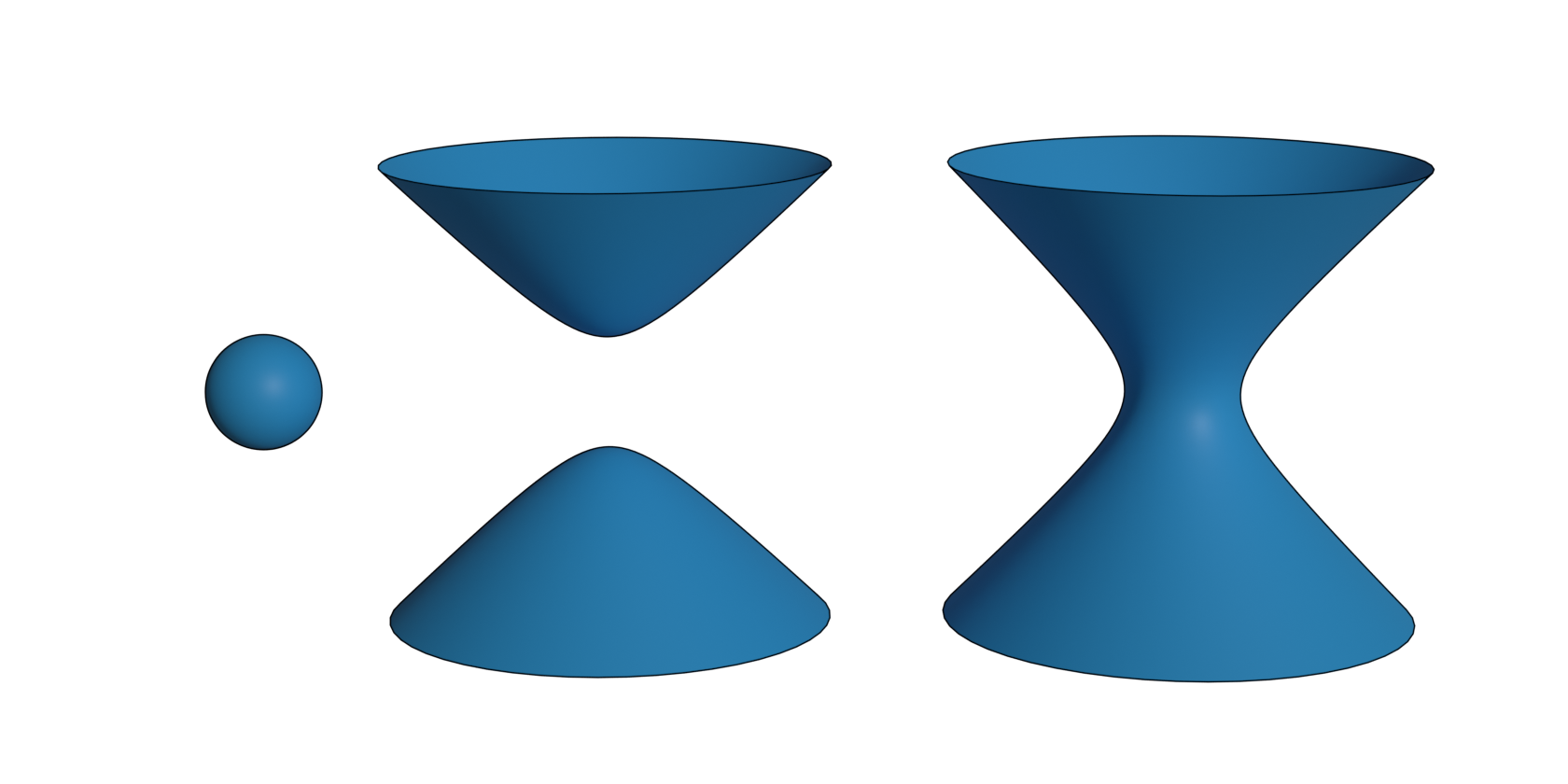
Visualizing Quadrics
See also
Visualizing ddg objects in Blender for a
general guide on visualization of ddg objects in Blender and
usage of to_blender_object()
and to_blender_object_helper().
For visualization in Blender, a Quadric needs to be
converted to a
SmoothNet
(SmoothCurve).
This has to be converted to a DiscreteNet (or a
DiscreteCurve), which is achieved by sampling.
This conversion and sampling can be done
manually and the DiscreteNet
can be handed to to_blender_object(). Alternatively,
Quadric can be handed to
to_blender_object_helper() which combines the
conversion, the sampling and the call of to_blender_object().
Using to_blender_object
A Quadric can be converted to a
SmoothNet that can be sampled to a
DiscreteNet. The function
sample_smooth_net
requires a sampling.
>>> import ddg
>>> import numpy as np

>>> sphere = ddg.geometry.quadrics.Quadric(np.diag([1, 1, 1, -1]))
>>> snet = ddg.to_smooth_net(sphere, affine=True)
>>> dnet = ddg.sample_smooth_net(snet, sampling=[0.5, 10, "c"])
Note
When using to_smooth_net for visualization we need the argument
affine=True for visualization in affine coordinates.
The DiscreteNet can be visualized:
>>> blender_object = ddg.to_blender_object(dnet)
General arguments of the function to_blender_object() can
be found in its api documentation: to_blender_object().
Depending on the type of the resulting DiscreteNet, i.e. the dimension of the Quadric,
additional arguments can be given to
to_blender_object():
Options for DiscreteNet:
- boundingint (default=10)
Used to bound unbounded domains of nets.
- only_wirebool (default=False)
When True, only the wireframe of the net will be created.
Options for DiscreteCurve:
- boundingint (default=10)
Used to bound unbounded domains of nets.
- curve_typestring (default=’POLY’)
Blender curve type. See the Blender docs for all available types.
- curve_propertiesdictionary (default={‘bevel_depth’: 0.015})
Dictionary containing Blender curve properties. See the Blender docs for all available properties.
Options for PointNet:
- sphere_radiusfloat (default=0)
Radius of the sphere representing a point.
- sphere_subdivisionint (default=3)
How many subdivisions will be applied to the sphere.
See also
Using to_blender_object_helper
The function to_blender_object_helper()
combines the following
easy handling of commonly used keyword arguments
conversion to objects that can be visualized
calling the function
to_blender_object().
A Quadric can be handed directly to
to_blender_object_helper() together with a
sampling.
>>> quadric = ddg.geometry.quadrics.Quadric(np.diag([1, 1, -1, -1]))
>>> blender_object = ddg.to_blender_object_helper(quadric, sampling=[0.1, 50, "c"])
General arguments of the function to_blender_object_helper() can
be found in its api documentation: to_blender_object_helper().
There are additional arguments for Quadrics and further for the (converted) Nets, depending on the dimension of the Quadric:
Options for Quadrics:
- affinebool (default=False)
Whether the resulting SmoothNet should return affine or homogeneous coordinates (see
quadric_to_smooth_net()).- domainlist or SmoothDomain (default=None)
Optionally a domain to assign to the SmoothNet (see
ddg.datastructures.nets.utils.create_subdomain(),to_smooth_net()).
Options for SmoothNet:
- samplinglist, int or float
See
ddg.datastructures.nets.conversion.sample_smooth_domain().- anchorlist or None
Anchor point for sampling process.
- atollist, int or float
Tolerance(s) for sampling process.
Options for DiscreteNet:
- boundingint (default=10)
Used to bound unbounded domains of nets.
- only_wirebool (default=False)
When True, only the wireframe of the net will be created.
Options for DiscreteCurve:
- boundingint (default=10)
Used to bound unbounded domains of nets.
- curve_typestring (default=’POLY’)
Blender curve type. See the Blender docs for all available types.
- curve_propertiesdictionary (default={‘bevel_depth’: 0.015})
Dictionary containing Blender curve properties. See the Blender docs for all available properties.
Options for PointNet:
- sphere_radiusfloat (default=0)
Radius of the sphere representing a point.
- sphere_subdivisionint (default=3)
How many subdivisions will be applied to the sphere.
See also
Examples
>>> sphere = ddg.geometry.quadrics.Quadric(np.diag([1, 1, 1, -1]))
>>> sphere = ddg.to_blender_object_helper(
...     sphere, sampling=[0.1, 20, "c"], name="sphere"
... )

>>> two_sheeted_hyperboloid = ddg.geometry.quadrics.Quadric(
...     np.diag([1, 1, -1, 1])
... )
>>> two_sheeted_hyperboloid = ddg.to_blender_object_helper(
...     two_sheeted_hyperboloid,
...     sampling=[0.1, 20, "c"],
...     name="two_sheeted_hyperboloid",
...     location=[6, 0, 0],
...     bounding_box=[5, 5, 4],
... )

>>> one_sheeted_hyperboloid = ddg.geometry.quadrics.Quadric(
...     np.diag([1, 1, -1, -1])
... )
>>> one_sheeted_hyperboloid = ddg.to_blender_object_helper(
...     one_sheeted_hyperboloid,
...     sampling=[0.1, 20, "c"],
...     name="one_sheeted_hyperboloid",
...     location=[16, 0, 0],
...     bounding_box=[5, 5, 4],
... )