Curvature Circles
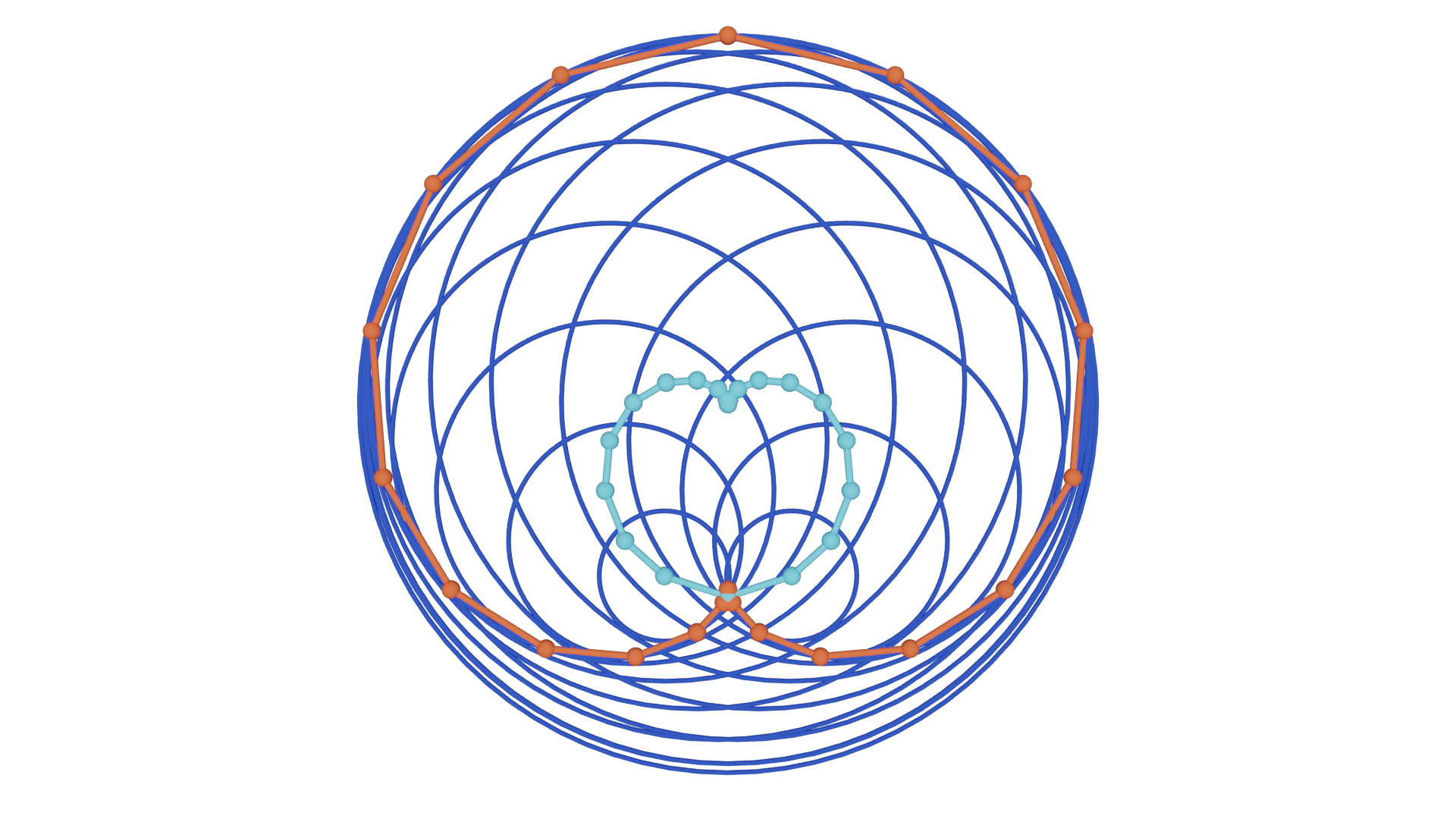
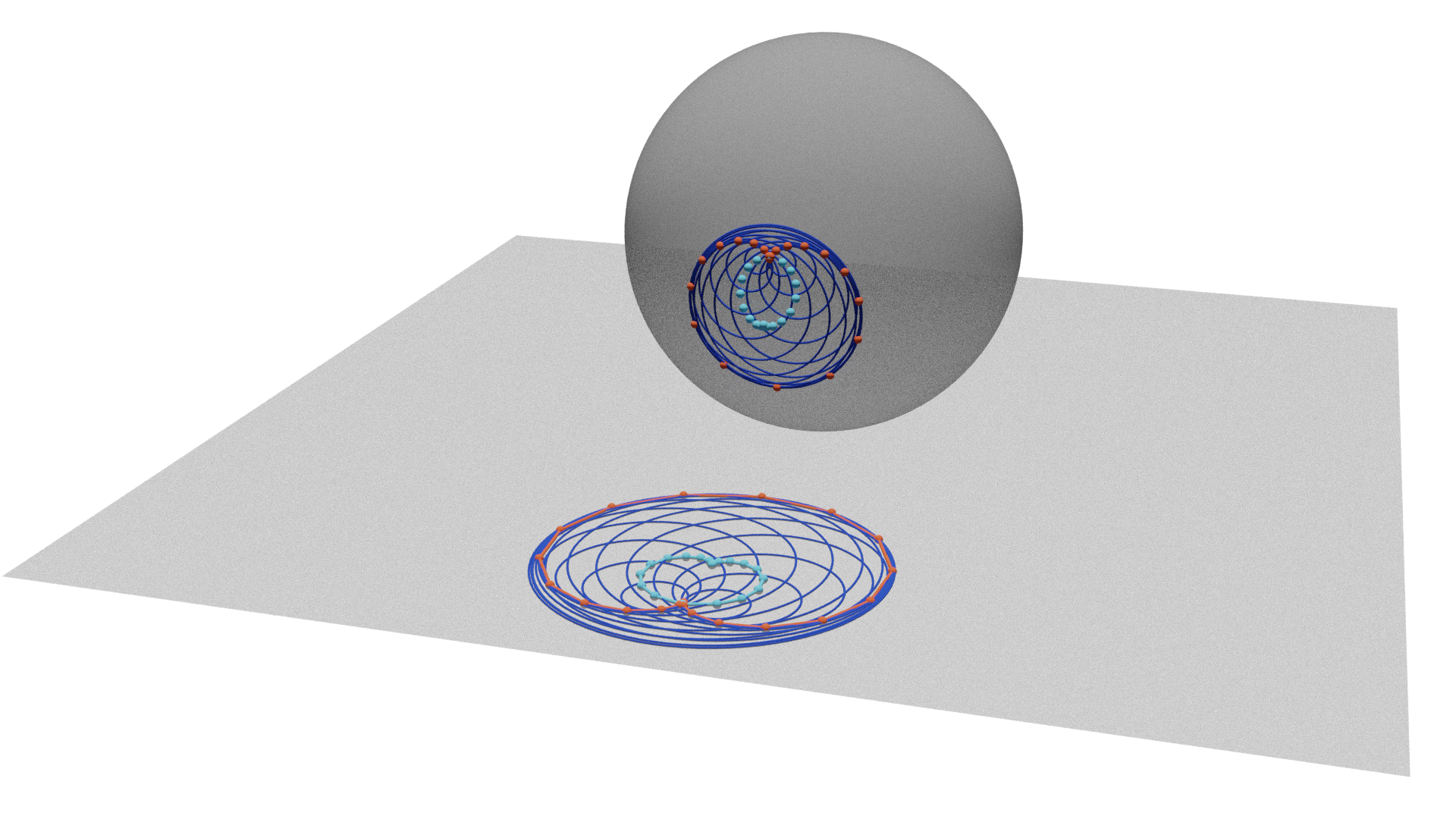
This example is about curvature circles of a (discrete) plane curve. It illustrates the relationship between the curvature circles of the plane curve and the ones of its counterpart on the Möbius sphere, obtained by inverse-stereographic projection of the planar points.
The curve in this example is a discrete cardioid.
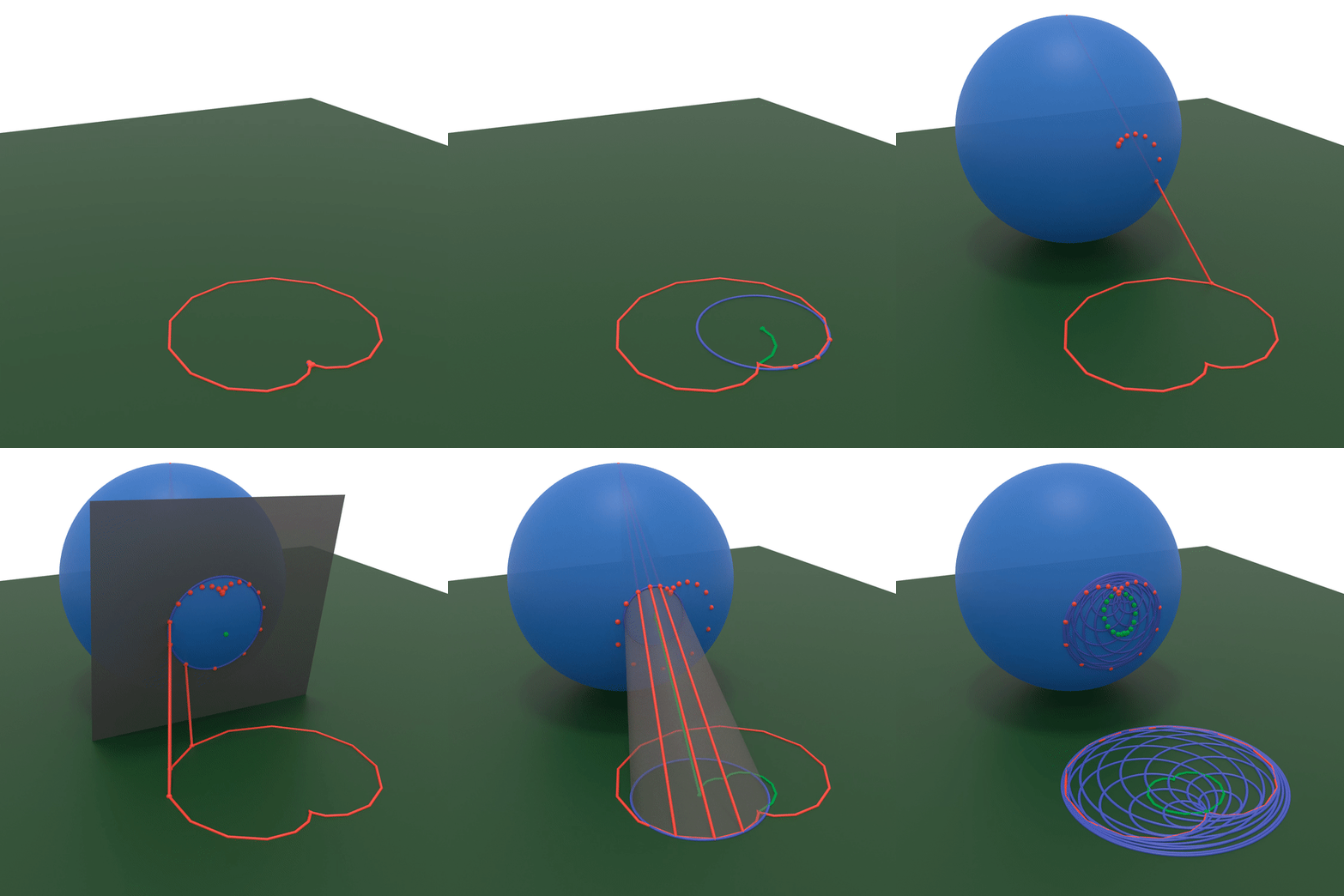
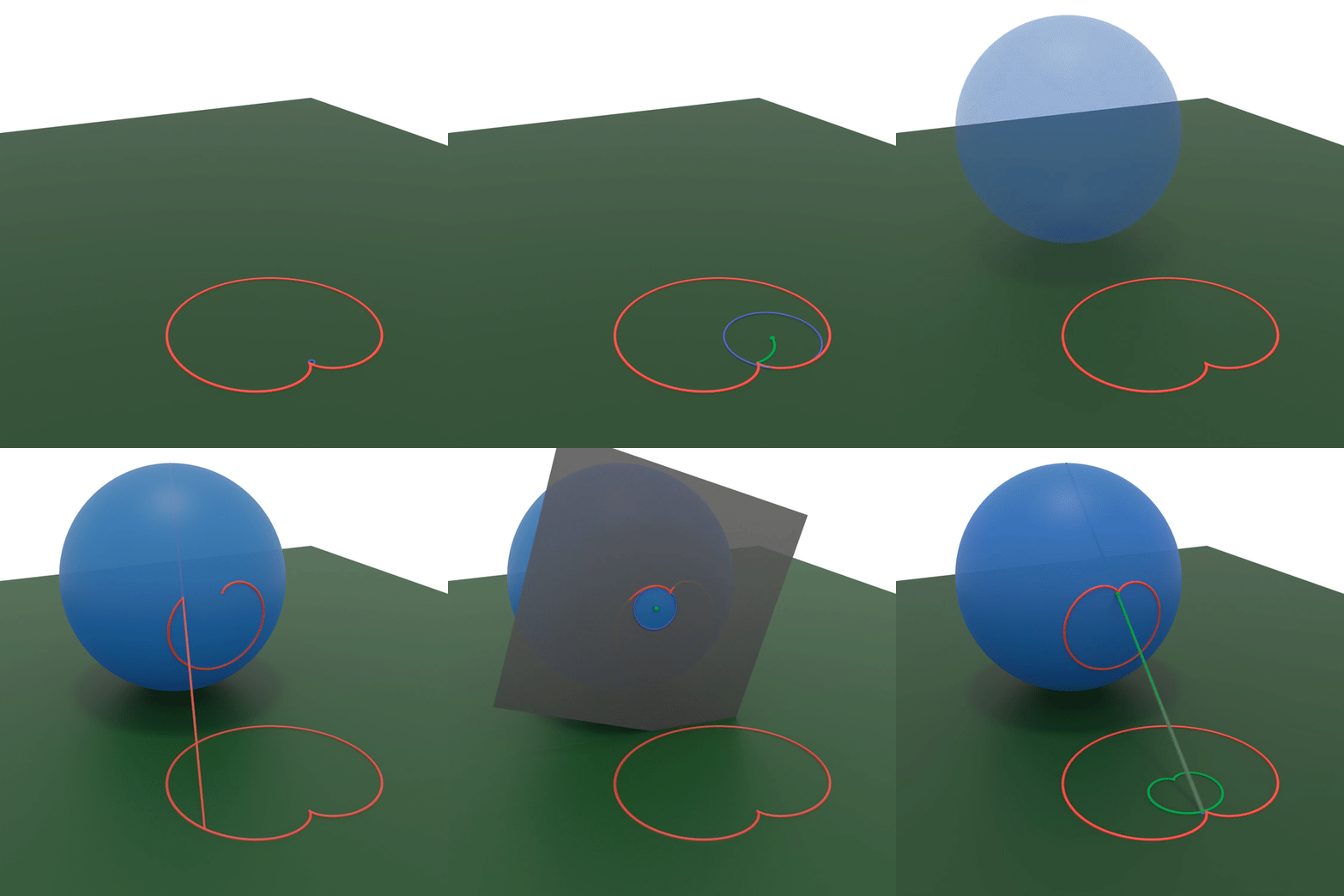
The example includes 7 animations:
Showing the discrete curvature circle at each point
Showing the discrete curvature circle at each point an tracking the evolute
Fade in of the Möbius sphere (only for smooth animations)
Inverse-steregraphic projection of each vertex to the Möbius sphere
Visualizing spherical circles as intersections of the sphere with osculating planes (and their polar points)
Stereographic projection of the spherical circles as well as their polar points
Tracking of all the (spherical and planar) objects by iterating through the curve (only for discrete animations)
Discrete animation:
Smooth animation:
You can download the full script
curvature_circles.py,
or find it, separated in sections, below.
Helper Functions
Functions for creation of planar and spherical curvature circles and projections of objects (per index).
##########################################
#  HELPER FUNCTIONS
##########################################

euc_3 = ddg.geometry.euclidean(3)


def circles(fct):
    """
    Returns a function that returns the discrete curvature circle at given index
    of the given discrete curve fct.
    The i'th curvature circle is given by the unique circle through the
    points fct(i-1), fct(i), fct(i+1).
    Domain: from 1 to n-1.
    """

    @lru_cache(maxsize=128)
    def circle(i):
        c, r, n = ddg.math.euclidean.circle_through_three_points(
            fct(i - 1), fct(i), fct(i + 1), atol=1e-17
        )
        euc_circle = euc_3.sphere_from_affine_point_and_normals(c, r, n)
        return euc_3.sphere_to_quadric(euc_circle)

    return circle


def inverse_project_fct(fct, sphere):
    """
    Returns a function that returns the projection of
    a given discrete curve fct to the quadric `sphere`.
    Each vertex of the discrete curve is inverse stereographically
    projected to `sphere`.
    """

    @lru_cache(maxsize=128)
    def inverse_project_v(i):
        p = ddg.geometry.Point(ddg.math.projective.homogenize(fct(i)))
        return ddg.geometry.inverse_stereographic_project(p, quadric=sphere)

    return inverse_project_v


def m_circles(g, sphere):
    """
    Assumes, that the function g returns Points on the quadric `sphere`.
    Returns a function that returns the Moebius circles.
    The i'th Moebius circle is given by the intersection of the sphere with
    the plane spanned by the points fct(i-1), fct(i), fct(i+1).
    Domain: from 1 to n-1.
    """

    @lru_cache(maxsize=128)
    def m_circle(i):
        plane = ddg.geometry.join(g(i - 1), g(i), g(i + 1))
        return ddg.geometry.meet(plane, sphere)

    return m_circle


def project_fct(g, plane):
    """
    Assumes, that the function fct returns projective objects
    in RP3.
    Returns a function that projects the objects to the plane, resulting
    in planar objects of the same type.
    Domain: from 0 to n.
    """

    @lru_cache(maxsize=128)
    def project_obj(i):
        proj_on_plane = ddg.geometry.stereographic_project(g(i), hyperplane=plane)
        return proj_on_plane

    return project_obj
Setup
#############################################
# CLEAR AND ADD COLLECTION FOR STATIC OBJECTS
#############################################

# Animated objects will be linked to their own collections
ddg.blender.scene.clear(remove_collections=True)
static_coll = ddg.blender.collection.collection("static")
animated_coll = ddg.blender.collection.collection("animated objects")

##########################################
# EUC PLANE AND MOB SPHERE
##########################################

plane_pt, plane_directions = [0, 0, -1], [[1, 0, 0], [0, 1, 0]]
plane = ddg.geometry.subspace_from_affine_points_and_directions(
    plane_pt, plane_directions
)
north_pole = ddg.geometry.euclidean_models.MoebiusModel(2).fixed_point
sphere = ddg.geometry.Quadric(np.diag([1, 1, 1, -1]))
Curve and Specified Helper Functions
Initialize the parameterized curve and create functions specified for this curve.
##########################################
# PLANE CURVE
##########################################
# (-a,0) and (a,0) are  the centers of circles which generate cardioid
a = 0.3
# translation of cardioid
b = [2.3, 0]


def f(t):
    return np.array(
        [
            2 * a * (1 - np.cos(t)) * np.cos(t) + b[0],
            2 * a * (1 - np.cos(t)) * np.sin(t) + b[1],
            -1,
        ]
    )


samples = 20  # 24 * 6 - 1
sampling_curve = [samples, "t"]
snet = ddg.nets.SmoothNet(f, [[0, 2 * np.pi, True]])
dnet = ddg.nets.sample_smooth_net(snet, sampling=sampling_curve)

##########################################
# FUNCTION CALLS
##########################################

# circles_fct(i) returns i'th curvature circle (as Quadric)
circles_fct = circles(dnet.fct)


# centers_fct(i) returns the center of the i'th curvature circle (as Point/Subspace)
@lru_cache(maxsize=128)
def centers_fct(i):
    circle = euc_3.quadric_to_sphere(circles_fct(i))
    return ddg.geometry.Point(circle.center.point)


# spherical_fct(i) returns the inverse stereographic
# projection of the i'th vertex (as Point/Subspace)
spherical_fct = inverse_project_fct(dnet.fct, sphere)
# m_circles_fct(i) returns the i'th curvature circle on the Moebius sphere (as Quadric)
m_circles_fct = m_circles(spherical_fct, sphere)


# m_centers_fct(i) returns polar point of the plane corresponding
# to the i'th curvature circle (as Point/Subspace)
@lru_cache(maxsize=128)
def m_centers_fct(i):
    return sphere.polarize(m_circles_fct(i).subspace)


# Function returning the stereographic projection of the projective objects.
projected_vertices_fct = project_fct(spherical_fct, plane)
projected_m_circles_fct = project_fct(m_circles_fct, plane)
projected_m_centers_fct = project_fct(m_centers_fct, plane)
Visualization Setup
##########################################
#  VISUALIZATION
##########################################

# Materials
orange = ddg.blender.material.material("orange", (1, 0.026, 0))
blue = ddg.blender.material.material("blue", (0.019, 0.052, 0.445))
lightgreen = ddg.blender.material.material("lightgreen", (0, 0.42, 0.078), 0, 0)
transparent_cone = ddg.blender.material.material(
    "transparent_cone", (0.2, 0.154, 0.154), alpha=0.3
)
transparency_sphere = 0.8
transparent_sphere = ddg.blender.material.material(
    "transparent_sphere", (0, 0.168, 0.6), 0.5, alpha=transparency_sphere
)
transparent_plane = ddg.blender.material.material(
    "transparent_plane", (0, 0.05, 0.005), 0.4
)
transparent_m_planes = ddg.blender.material.material(
    "transparent_m_planes", (0.06, 0.06, 0.06), alpha=0.9
)

# Distinguish weather to use settings for a smooth
# or a discrete version of the animation.
# For more than 40 samples we interpret the
# curve as a smooth curve.
discrete_animation = samples < 40

# Sampling and size settings for objects to visualize
plane_size = (4.5, 4.5)

bevel_curvature_circles = 0.01 if discrete_animation else 0.008
bevel_curve = 0.01

sampling_general = [0.1, 100, "c"]
sampling_polar_plane = 1
point_size = 0.02
Animation Setup and Static Objects
Don’t forget to set the output directory and increase the max_samples value.
##########################################
#  ANIMATION
##########################################
# Animation 1: Euclidean curvature circles
# Animation 2: Euclidean curvature circles with tracking of the evolute
# Animation 3: Fade in of the Moebius sphere
# Animation 4: Projection of planar vertices to the sphere
# Animation 5: Moebius circles as intersections of the sphere
# with planes through three consecutive points
# Animation 6: Project circles and polar points back to the plane
# Animation 7: Trace curvature circles on the plane and on the sphere

# For internal snapshot testing set animation_no=6
# For internal testing the max_samples are set low.
# For a qualitative good picture increase these, e.g. to 512
animation_no = 6
output_dir = "/tmp/"
samples = 8


# Static objects
# ----------------

# Plane
plane_bobj = ddg.blender.convert(
    plane,
    "plane",
    material=transparent_plane,
    collection=static_coll,
)

# Curve
bobj = ddg.blender.convert(
    dnet,
    "discrete curve",
    material=orange,
    collection=static_coll,
)
bobj.data.bevel_depth = bevel_curve

# Moebius sphere
if animation_no > 2:
    sphere_bobj = ddg.blender.convert(
        sphere,
        "sphere",
        material=transparent_sphere,
        collection=static_coll,
    )
    ddg.blender.mesh.shade_smooth(sphere_bobj)


# Fade in of the Moebius sphere
if animation_no == 3:
    frames_fade_in_sphere = 4 * 24
    ddg.blender.animation.animate_opacity(
        transparent_sphere,
        0,
        frames_fade_in_sphere,
        frames_fade_in_sphere + 1,
        frames_fade_in_sphere + 1,
        opacity_outer=0,
        opacity_inner=transparency_sphere,
    )

# Moebius curve
# discrete: set of Points, smooth: DiscreteNet -> Blender Curve object
if animation_no > 4:
    if discrete_animation:
        for i in range(samples):
            ddg.blender.vertices(
                spherical_fct(i),
                f"spherical point {i}",
                radius=point_size,
                material=orange,
                collection=static_coll,
            )
    else:

        def spherical_fct_affine(i):
            return spherical_fct(i).affine_point

        bobj_spherical_curve = ddg.blender.convert(
            ddg.nets.DiscreteNet(spherical_fct_affine, [[0, samples]]),
            "spherical curve",
            material=orange,
            collection=static_coll,
        )
        bobj_spherical_curve.bevel_depth = bevel_curve
Main Animation Function
def blender_objects(i):
    ddg.blender.collection.clear([animated_coll], deep=True)
    pts = [
        ddg.geometry.subspace_from_affine_points(p)
        for p in [dnet(i - 1), dnet(i), dnet(i + 1)]
    ]

    ##########################################
    #  PLANAR
    ##########################################

    # Vertices of the curve
    if animation_no in [1, 2, 4, 5] and discrete_animation:
        pts_tmp = [pts[1]] if animation_no == 4 else pts
        for i, p in enumerate(pts_tmp):
            ddg.blender.vertices(
                p,
                "animated planar point",
                radius=point_size,
                material=orange,
                collection=animated_coll,
            )

    # Curvature circles
    if animation_no in [1, 2, 6, 7]:
        bobj_circle = ddg.blender.convert(
            circles_fct(i),
            f"animated circle {i}",
            material=blue,
            collection=animated_coll,
        )
        bobj_circle.data.bevel_depth = bevel_curvature_circles
        bobj_circle

    # Curvature circe center and evolute trace
    if animation_no in [2, 6, 7]:
        # Curvature circle center
        ddg.blender.vertices(
            centers_fct(i),
            f"animated center {i}",
            radius=point_size,
            material=lightgreen,
            collection=animated_coll,
        )

        # Evolute curve
        def centers_fct_affine(i):
            return centers_fct(i).affine_point

        bobj_evolute = ddg.blender.convert(
            ddg.nets.DiscreteNet(centers_fct_affine, [[0, i]]),
            f"evolute {i}",
            material=lightgreen,
            collection=animated_coll,
        )
        bobj_evolute.data.bevel_depth = bevel_curve

    #########################################
    #  PROJECTION TO THE SPHERE
    ##########################################

    # Projection to sphere visualized as line
    if animation_no in [4, 5, 6]:
        pts_tmp = [pts[1]] if animation_no == 4 else pts
        # Line as join of the North Pole and curve's vertex
        if animation_no == 4 or discrete_animation:
            for j, p in enumerate(pts_tmp):
                line_segment = ddg.arrays.line_segment_from_points(
                    north_pole.affine_point, p.affine_point
                )
                bobj_spherical_projection = ddg.blender.convert(
                    line_segment,
                    f"spherical projection {i}_{j}",
                    material=orange,
                    collection=animated_coll,
                )
                bobj_spherical_projection.data.bevel_depth = bevel_curvature_circles

    # Track of Moebius curve, discrete: set of Points, smooth: DiscreteNet
    if animation_no in [4]:
        if discrete_animation:
            ddg.blender.vertices(
                spherical_fct(i),
                f"spherical point {i}",
                radius=point_size,
                material=orange,
                collection=animated_coll,
            )
        else:

            def spherical_fct_affine(i):
                return spherical_fct(i).affine_point

            bobj_spherical_curve = ddg.blender.convert(
                ddg.nets.DiscreteNet(spherical_fct_affine, [[0, i]]),
                f"spherical curve {i}",
                material=orange,
                collection=animated_coll,
            )
            bobj_spherical_curve.bevel_depth = bevel_curve

    ##########################################
    #  MOEBIUS PLANES AND CIRCLES
    ##########################################
    # Catch if a circle degenerates in a cusp of the curve
    non_degenerate = ddg.geometry.signatures.Signature(2, 1, 0)
    if m_circles_fct(i).signature() == non_degenerate:
        # Moebius planes
        if animation_no in [5]:
            center = ddg.geometry.quadric_to_euclidean_sphere(m_circles_fct(i)).center
            plane = m_circles_fct(i).subspace.orthonormalize_and_center(center=center)
            ddg.blender.convert(
                plane,
                f"Moebius plane {i}",
                material=transparent_m_planes,
                collection=animated_coll,
            )

        # Moebius curvature circle
        if animation_no in [5, 6, 7]:
            # Track in animation_no = 7
            bobj_m_circle = ddg.blender.convert(
                m_circles_fct(i),
                f"Moebius curvature circle {i}",
                material=blue,
                collection=animated_coll,
            )
            bobj_m_circle.data.bevel_depth = bevel_curvature_circles
            bobj_m_circle

        # Moebius polar point
        if animation_no in [5, 6, 7]:
            # Track in animation_no = 7
            bobj_m_center = ddg.blender.vertices(
                m_centers_fct(i),
                f"Moebius polar point {i}",
                radius=point_size,
                material=lightgreen,
                collection=animated_coll,
            )
            bobj_m_center

    ##########################################
    #  PROJECT BACK
    ##########################################
    # Projection cone and line
    if animation_no in [6]:
        cone = ddg.geometry.join(north_pole, circles_fct(i))

        # Projection cone
        bobj_projection_cone = ddg.blender.convert(
            cone,
            f"projection cone {i}",
            material=transparent_cone,
            collection=animated_coll,
        )
        ddg.blender.mesh.shade_smooth(bobj_projection_cone)

        # Cut cone on one side
        with ddg.blender.bmesh.bmesh_from_mesh(bobj_projection_cone.data) as bm:
            ddg.blender.bmesh.cut_bounding_box(
                bm, np.array([3, 3, 3]), np.array([3, 0, 0])
            )

        # Projection line
        line_segment = ddg.arrays.line_segment_from_points(
            north_pole.affine_point, centers_fct(i).affine_point
        )
        bobj_projection_line = ddg.blender.convert(
            line_segment,
            f"projection line {i}",
            material=lightgreen,
            collection=animated_coll,
        )
        bobj_projection_line.data.bevel_depth = bevel_curve
Animation Callback and Keyframes
##########################################
# Animation Setup
##########################################

ddg.blender.animation.clear_animation_data(bpy.context.scene)

ddg.blender.props.add_props_with_callback(blender_objects, ("i"), 0)

ddg.blender.animation.set_keyframe(bpy.context.scene, 0, "i", 0)
ddg.blender.animation.set_keyframe(bpy.context.scene, samples, "i", samples)

bpy.context.scene.frame_end = samples if animation_no != 3 else frames_fade_in_sphere
bpy.context.scene.frame_start = 0
bpy.context.scene.frame_current = 0
Rendering Setup
##########################################
# RENDERING SETUP
##########################################

# Add light and camera
cam = ddg.blender.camera.camera(location=(5.1, -2, 1.5))
ddg.blender.camera.look_at_point(cam, (0, 0.5, -1))
light = ddg.blender.light.light(location=(4, 0, 20), energy=1)
ddg.blender.light.look_at_point(light, (5, 0, 0))
light.data.angle = 0.17

# Setup rendering
ddg.blender.render.setup_cycles_renderer(samples=samples)
ddg.blender.render.set_world_background((0.7, 0.7, 0.7, 1), 1)
bpy.context.scene.render.resolution_x = 1500
bpy.context.scene.render.resolution_y = 1500
ddg.blender.render.set_film_transparency()
bpy.context.scene.view_settings.view_transform = "Standard"
ddg.blender.render.set_render_output_images(
    output_dir,
    time=False,
    file_format="PNG",
    alpha=True,
)